
How to Tell If a Pokémon Card Is Fake: A Practical Checklist
Counterfeit Pokémon cards have gotten much better. Here's how to tell a real card from a fake in under two minutes.
Fake Pokémon cards have gotten significantly better over the past few years. The days when you could spot a counterfeit instantly from across the table are mostly over. Modern fakes use better cardstock, better printing, and more convincing holofoil patterns — and if you’re buying online, you’re working from photos that can hide a lot.
Here’s how to check a card properly when it matters.
The light test — your first move
Hold the card up to a light source and look through it.
Real Pokémon cards have a specific layered construction — a dark black layer runs through the middle of the card, sandwiched between lighter paper layers. When you hold a genuine card up to light, you can see that dark band through the center.
Most counterfeits either lack this layer entirely or have it inconsistently placed. If the card is uniformly translucent with no visible dark band, it’s almost certainly fake.
This one test catches the majority of counterfeits and takes about three seconds.
Texture and feel
Run your thumb across the back of the card. Real Pokémon cards have a specific texture — slightly rough, consistent, with a firm snap to them. When you gently flex the card between your fingers and release, it springs back with resistance.
Fakes come in two flavors: too smooth (printed on photo paper or a glossy substrate), or wrong kind of rough (cheap cardstock that feels grainy in the wrong direction). The flex test helps too — fakes are often either too stiff or too floppy compared to the real thing.
This takes a few seconds of handling genuine cards before you can really calibrate it, but once you’ve held enough real cards, wrong feels obvious.
Print quality under magnification
Real Pokémon cards are printed using a process that produces very fine, regular color dots. Under 10x magnification — a jeweler’s loupe, or just your phone’s camera zoomed in — you’ll see a precise dot pattern with clean edges.
Fakes typically show one of two things: a visible grid-like halftone pattern (cheap consumer printing), or blurry edges where the ink has spread and the dots run together.
The card text is another useful tell. On a genuine card, the font is sharp with no ink bleeding at the letter edges. On a fake, text often looks subtly soft, like it was printed slightly out of focus.
Color saturation
Counterfeits almost always print too saturated. Colors that are supposed to be slightly restrained come out too vivid on fakes — the yellow of a Pikachu card reads as neon where it should be warm and muted. Reds are too aggressive. The overall look of the card feels slightly off before you can even articulate why.
This is very hard to judge from a single card in isolation, but becomes obvious the moment you hold a suspected fake next to a card you know is genuine.
Holofoil: the hardest thing to fake convincingly
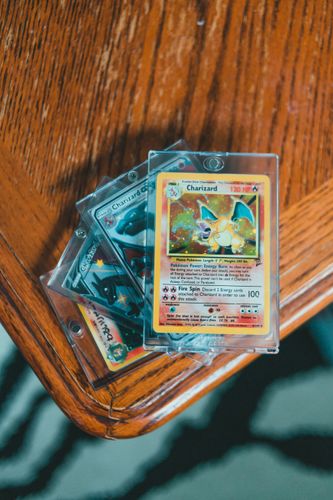
Holographic cards are both the most counterfeited and the hardest to replicate well. The holofoil on real Pokémon cards has a specific depth and pattern that varies by era and set — but it’s always clearly three-dimensional, not a flat reflective surface.
On fake holo cards:
- The pattern often looks flat, more like a reflective sticker than actual foil
- The holo layer sometimes doesn’t extend to the right areas of the art
- Under direct light, real holofoil breaks into the set-specific pattern; fakes tend to produce a generic sparkle or rainbow sheen
If you can put a suspected fake holo next to a verified genuine card from the same set, the difference is usually immediately obvious. The fake looks cheaper, even if you can’t say exactly why at first.
When buying online
Online purchases are where most people get burned, because you’re working from photos and can’t physically inspect the card. When buying anything high-value:
Ask the seller for a photo of the card held up to a light source (the light test is hard to fake in a photo), a photo of the back, and a close-up of the bottom-right corner where the HP and damage numbers are printed.
Be skeptical of prices that don’t make sense. A PSA-grade-worthy Charizard at half market value from a seller with no feedback history is not a deal — it’s a counterfeit or a stolen card.
One more check
If you’ve scanned the card with Scryda and the app matches it confidently to a specific set, number, and edition, that’s a reasonable data point. The visual pattern matching picks up on characteristics of the card that match the database. A card that’s off enough visually to fool that match in a specific wrong direction is unusual.
That said, don’t use an app match as your only verification on anything worth real money. Use it alongside the physical checks above, not instead of them.
The realistic takeaway
No single test is definitive on its own. The light test is your fastest and most reliable filter — do it first. After that, texture and print quality are the most consistent physical tells.
Develop your eye by handling as many genuine cards as you can. The more real cards you’ve touched, the faster wrong starts to feel wrong. Most experienced collectors spot a fake within a few seconds of picking it up, not because they’re running through a checklist, but because the feel is just off.
The counterfeit market targets high-value cards specifically — nobody prints fake $1 commons. If you’re buying anything worth $50 or more from an unfamiliar source, the extra minute of inspection is always worth it.
Share this article
Related articles


